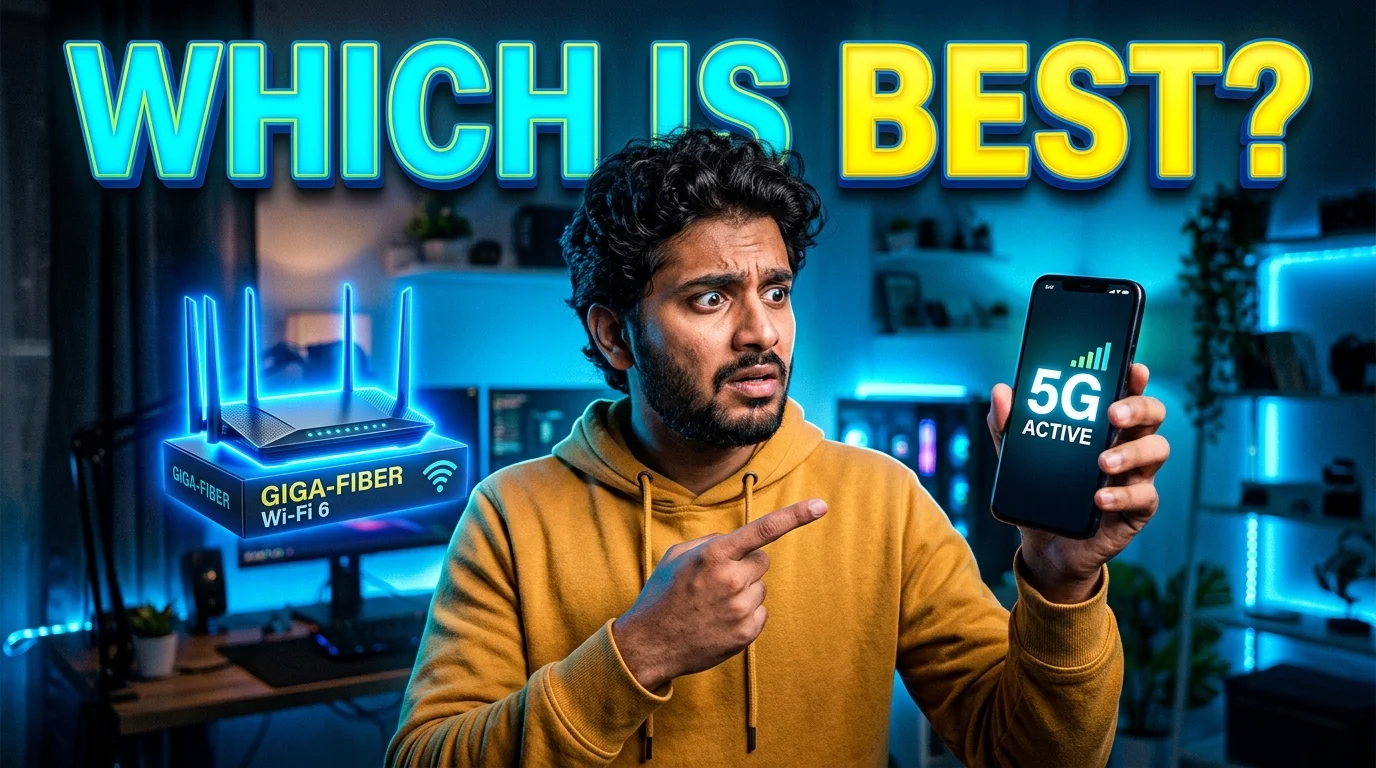
A few years ago, everyone had a broadband wire coming into their house. Now, mobile 5G is so fast (often crossing 300 Mbps) that many people just turn on their phone's mobile hotspot and connect their smart TV, laptop, and iPad to it.
It sounds like a smart way to save money, right? But Jio recently launched Jio AirFiber, a dedicated wireless home box. If your phone already gives you 5G speed, why should you pay extra for AirFiber? Which one is actually better for your home? Let's break it down simply.
By the way, if you are sticking with your mobile hotspot for now but notice the speed dying in the evening, read our guide on why Jio 5G gets slow at night and how to fix it.
THE HIDDEN COST OF MOBILE HOTSPOTS
Using your Jio 5G phone as a permanent home Wi-Fi destroys your smartphone. Here is why:
Generating a Wi-Fi signal while simultaneously pulling down 5G data from the tower makes your phone incredibly hot. If you do this every day while watching Netflix or downloading big files, this extreme heat will permanently damage your phone's battery capacity within just a few months. A battery replacement will cost you much more than a Wi-Fi bill.
Secondly, it is extremely annoying for your family. The moment you walk out of the house to buy groceries and take your phone with you, the entire house loses the internet.
WHAT MAKES JIO AIRFIBER DIFFERENT?
Jio AirFiber uses the exact same 5G network as your mobile phone. It does not use physical fiber optic wires from the street. However, the hardware makes a massive difference.
With AirFiber, Jio installs a dedicated, high-powered antenna on your roof or balcony. This antenna has a clear, direct line-of-sight to the mobile tower. A wire then connects this antenna to a proper Wi-Fi router inside your house.
The 3 Big Advantages of AirFiber:
- Better Stability: Because the antenna is outside, it never struggles with thick concrete walls like your mobile phone does when you sit in a closed bedroom.
- More Devices: A proper router can easily handle 20+ smart devices at once. A mobile phone hotspot usually crashes or slows down drastically after 4 or 5 devices connect to it.
- Always On: It stays at home. Your family can watch smart TV even when you are not there.
SPEED AND GAMING PING COMPARISON
If you stand outside your house, your mobile 5G speed might actually beat AirFiber on a speed test app. Mobile 5G often hits 500 Mbps, while AirFiber plans are capped at 30 Mbps, 100 Mbps, or 1 Gbps depending on what you pay for.
However, for gamers (like BGMI or Free Fire players), AirFiber is much better. Because the outdoor antenna never moves and has a clear view of the tower, your ping (latency) remains much more stable. Your mobile phone's ping will constantly jump up and down as you move around the house.
If you want to see your current stability, run a quick check on our Live Speed Test Tool.
THE FINAL VERDICT: WHICH ONE SHOULD YOU GET?
If you live alone in a single room and just occasionally need to connect your laptop to check emails, your Jio 5G mobile hotspot is perfectly fine. Don't waste money on a separate connection.
But if you have a family, multiple smart TVs, or you work from home doing Zoom video calls all day, you absolutely need Jio AirFiber. It gives you the freedom of a wireless setup with the stability of a real router.
(Note: If traditional wired JioFiber or BSNL Bharat Fiber is available in your street, always choose the physical wire over wireless. Real wires will always give you the absolute lowest ping for gaming.)
FAQ:-
Do you need a wire connection from the street for Jio AirFiber?
No. It is a completely wireless system. The only wire used is a small cable connecting the outdoor antenna on your roof to the indoor router in your living room.
Can I take the Jio AirFiber box to another city?
No. Unlike a portable JioFi dongle, Jio AirFiber is location-locked. It will only work at the specific address where the Jio engineer installed it.
Is the speed on Jio AirFiber truly unlimited?
Yes, but there is a Fair Usage Policy (FUP). After you cross 1000 GB (1 TB) of data in a single month, your speed will be reduced for the rest of that month. However, 1000 GB is usually more than enough for a normal family.